

Keep More of What You’ve Built
A tax-aware long/short strategy designed to seek growth and reduce what you lose to taxes each year
If you have meaningful taxable
wealth, this probably feels familiar:

Distributions that Trigger a Tax Bill Every Year

A Concentrated Position You Can’t Easily Sell

Fragmented Portfolios with Embedded Gains

A Windfall Liquidity Event - and a looming tax decision
Selling, simplifying, or reallocating can trigger large tax bills.
Over time, taxes create drag that compounds and gradually reduces what you keep.
Illustrative Impact of Tax Drag
A $10M taxable portfolio, 20 years, 8% pre-tax return and
2% annual tax drag from capital gains distributions, dividends, turnover and rebalancing.
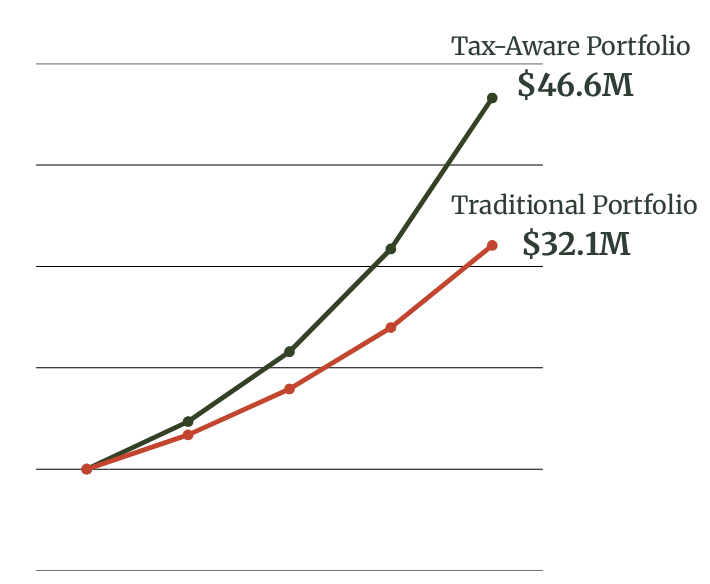
Hypothetical example for educational purposes only; not actual results. This example assumes a constant rate of return and tax rate and does not reflect any specific investment or strategy. Actual results will vary and may be higher or lower, It is not a forecast or guarantee and does not represent the experience of any client or portfolio.
Same market exposure.
Different tax experience.t
$14.5M
Lost to Tax Drag*
*Illustrative, not actual results)

The Bootpack Tax-Aware
Long/Short Strategy
A tax-aware long/short strategy treats after-tax return as the only return that matters.
By combining attractive long positions with short positions that hedge risk and often generate losses, the strategy creates a structure that actively manages your tax burden — not as an afterthought, but as a core performance driver.
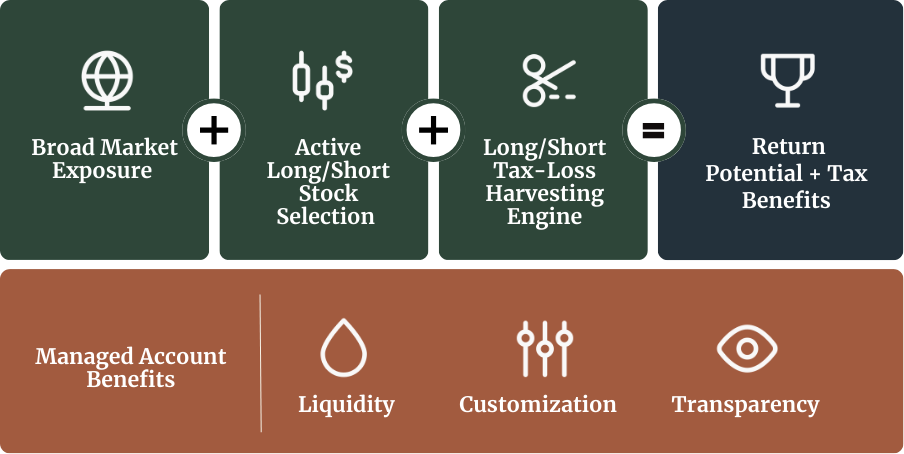
Now available to investors in Managed Accounts at our Custodian, Charles Schwab & Co.
How It Works
A long/short structure designed to keep broad market exposure, add active stock selection, and seek to generate capital gains losses, so you stay in equities, with a more tax-efficient experience.
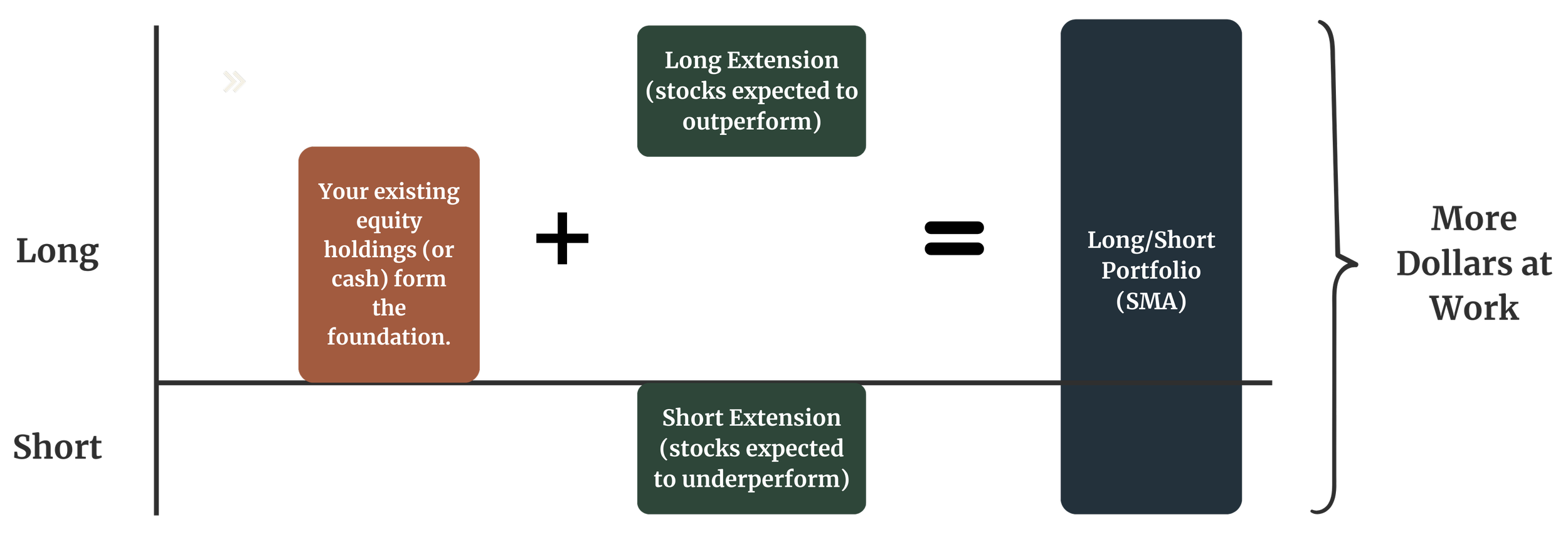
Investment results and tax benefits are not guaranteed. Results will vary based on individual circumstances, market conditions, and strategy configuration.
The Dual Potential of
Tax-Aware Long/Short Strategies
The Performance
Advantage:
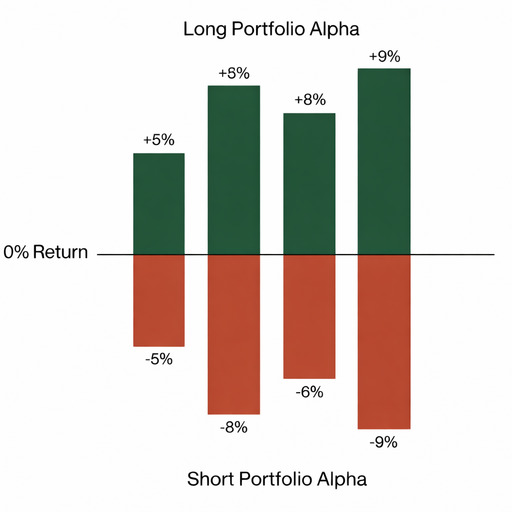
The potential to generate attractive returns on both the long and short sides of the portfolio compared with a traditional long‑only approach.
The Tax
Advantage:
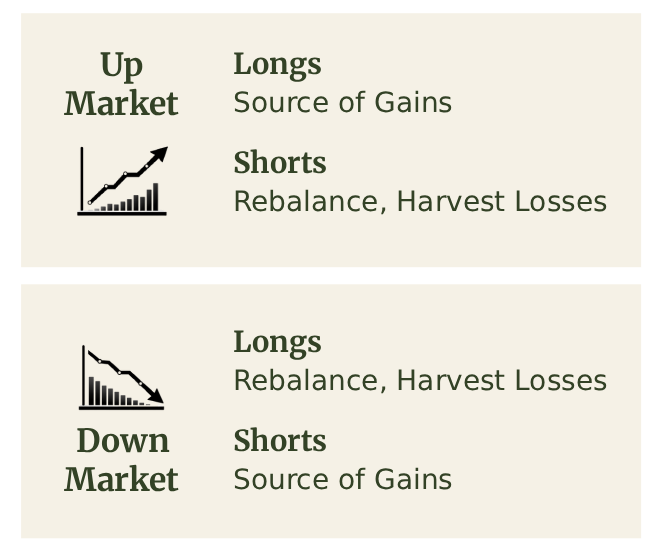
The ability to systematically seek capital losses on both the long and short sides of the portfolio in both up and down markets
Hypothetical illustration only. There is no guarantee the strategy will achieve positive returns or tax benefits.
What This Strategy Is Designed to Achieve
Potential outcomes when tax-aware portfolio construction is applied thoughtfully:

Tax Deferral:
Aims to defer capital gains across the entire portfolio and manage the timing of tax realization
Transition Concentrated Positions:
May help investors gradually diversify concentrated holdings while managing tax impact.

Core Equity Exposure:
Designed to serve as a tax-aware core equity allocation within a diversified portfolio.

Active Return Potential:
Uses long and short positions to seek incremental return beyond market exposure.

Portfolio Integration:
Designed to complement other investments as part of a broader wealth strategy.

How Clients Use This Strategy*
Long-Only Direct Indexing vs. Tax-Aware Long/Short
Direct Indexing
Broad market exposure, low tracking error
Often underperforms benchmark net of fees
Tax Benefits mostly in down markets
Tax benefits that tend to decline after a few years
Commoditized strategy
vs
Tax Aware Long/ Short SMAs
Broad market exposure, low tracking error
Potential for pre-tax outperformance, net of fees
Potential tax benefit in all market environments
Tax benefits may continue in perpetuity
Manager selection paramount to achieve pre-tax alpha
Comparative statements are general in nature and not a guarantee of results. Manager selection and individual circumstances significantly affect outcomes.
Why Work with Bootpack

Institutional-grade investment engine
We partner with a leading quantitative firm (approximately $189B) that pioneered tax-aware long/short strategies.

Deep long/short expertise applied to taxable portfolios
We focus on role, sizing, risk oversight, and setting the right expectations.

Integrated planning, not a stand-alone product
We coordinate implementation with your balance sheet, tax picture, low-basis holdings, and transition plan.

Lower minimums
Access begins at $2.5M, where many platforms require substantially more.
How It’s Delivered


The Advisor
Strategy selection, customization, risk monitoring, manager and client relationship.

The Investment Engine
A leading $189B quantitative investing firm founded in 1998 - a pioneer in tax-aware L/S strategies

The Custodian
SMA structure, daily transparency, liquidity and safety of assets
Onboarding Workflow
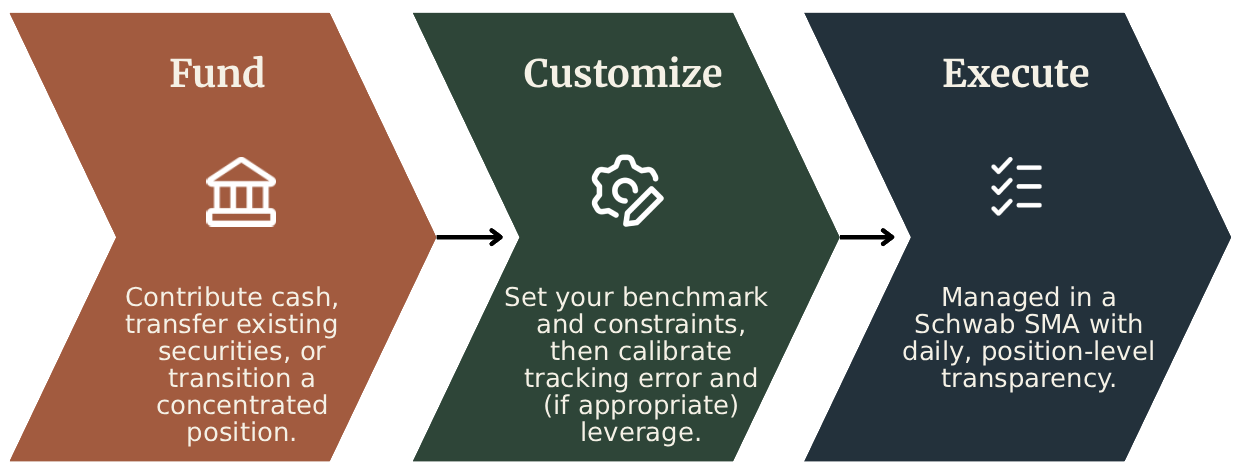
From your current holdings to a customized Schwab SMA, in three steps.

Built-In Trade-Offs, Honestly Explained
Every strategy involves trade-offs. Here's exactly what to expect from this one.

Tracking Error
The portfolio will deviate from the benchmark. This active risk is necessary in seeking outperformance.

Leverage Costs
Financing rates apply to the leveraged portion. Costs are managed, but fluctuate with interest rates.

Shorting Risks
Potential for unlimited losses in theory, but mitigated by diversification (hundreds of positions)

Tax Complexity
L/S portfolios involve 1000s of positions, requiring extensive reporting & coordination with a CPA

Tax Deferral, Not Elimination
Tax benefits reflect deferral, not elimination. Timing is managed, but taxes may be owed later.
Tax-Aware Long/Short
Frequently Asked Questions
-
The portfolio is managed by one of the most respected quantitative investment firms in the world — a firm that has spent over two decades at the frontier of systematic, factor-based investing. Founded in 1998 by a team of pioneering researchers, they manage approximately $189 billion across global strategies and are widely regarded as one of the firms that defined the modern science of quantitative investing.
Their work on tax-aware long/short strategies specifically is not a product extension — it is core to what they built. They have published extensively on the academic foundations of factor investing, tax efficiency, and portfolio construction, and their research shapes how the broader industry thinks about these problems.
Bootpack works with this firm not as a distributor, but as an advisor — selecting the right strategy, calibrating it to your situation, and coordinating implementation across your full financial picture.
-
Three dimensions can be tailored to your situation:
Benchmark — Choose from Russell 1000 (large-cap U.S.), Russell 3000 (broad U.S. market), or a global equities index, depending on your existing exposure and preferences.
Beta — Select how closely the portfolio tracks that benchmark. A beta of 1.0 means full market exposure; 0.5 means roughly half the market sensitivity; 0.0 means market-neutral. This determines how much directional equity risk the portfolio carries.
Tracking error — This is the degree to which the portfolio's returns are allowed to deviate from the benchmark. A higher tracking error gives the investment manager more flexibility to pursue active stock selection — more potential for outperformance, but also more potential for underperformance relative to the index. It also creates more opportunity for tax-loss harvesting, as a broader range of positions can be rotated for tax purposes. A lower tracking error keeps the portfolio closer to benchmark behavior with a tighter risk profile and somewhat fewer harvesting opportunities.
-
The strategy comes in multiple configurations: different benchmarks, different levels of leverage, different tracking error targets, and different beta exposures. Each combination has its own return profile and its own tax harvesting potential. Collapsing that into one track record or one tax savings figure would be misleading.
Tax savings are also an output, not a fixed input. They depend on your specific situation — your cost basis, your existing gains, your tax rate, and how the strategy is configured for you. A number quoted before understanding your circumstances wouldn't mean much.
What we do instead: once we've identified the right strategy configuration for your situation, we'll walk you through the relevant performance history and illustrative tax benefit analysis in full — transparently, with appropriate context. You'll have everything you need to make an informed decision before committing to anything.
-
There are three components to the all-in cost.
Schwab charges a financing fee based on the margin required by the strategy — this varies depending on strategy type and portfolio size.
The investment manager charges a management fee for running the long/short engine. There is no incentive fee.
And Bootpack charges an advisory fee for strategy selection, customization, ongoing oversight, and coordination with your broader financial plan.
We walk through all three transparently at the outset of every engagement — and for qualifying portfolios, the after-tax benefit is intended to meaningfully offset the total cost.
-
Many hedge funds do run long/short strategies, so the comparison is understandable.
But the structure here is fundamentally different. This is a separately managed account (SMA) held in your name at Charles Schwab — not a pooled fund. You own the individual securities directly, which is what makes position-level tax management possible.
There are no lock-ups, no limited partnership interests, and no commingled capital. You have full transparency and liquidity.
-
The strategy is available to investors with $2.5M or more in taxable assets.

Make Your Taxable Portfolio
Work Harder
Want to see whether this fits your situation? We’ll review your current holdings, goals, and tax picture, then walk through how a tax-aware long/short strategy could be implemented alongside your existing plan.